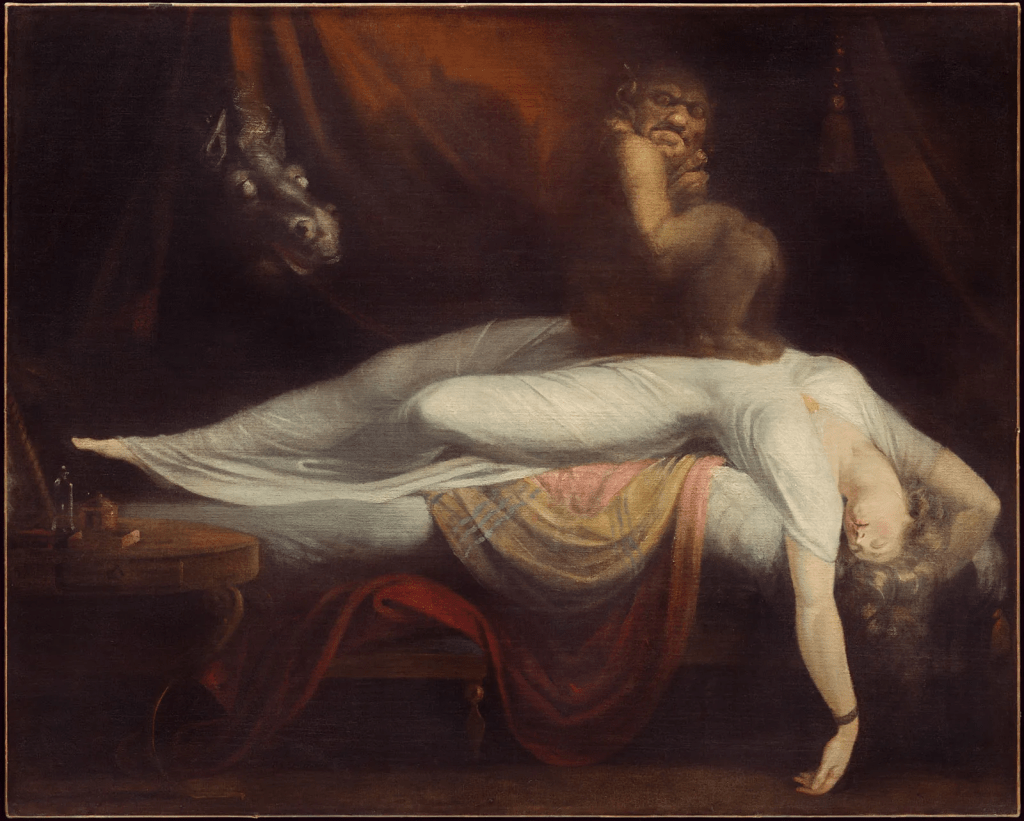
The view keeps what looks back.
The village was flat and unremarkable, except for a single hill to the North. It rose like a spire, tapering into the sky. From its peak, a faint glow pulsed. An unspoken promise that if you climbed the hill, you’d reach the stars.
The girl stared out her window. The glow from the hill was so bright that it slipped through her shutters, casting light across her room. Her grandma sat on the edge of the bed reading aloud, but the girl wasn’t listening.
“Granny,” she interrupted, “Why does no one climb the hill?”
Her grandmother lowered the book. “Because it’s not allowed.”
“Why not?” the girl asked, frowning.
“It’s too high. You could fall.”
“I don’t believe that no one’s tried.”
“They have,” her grandmother said. “That’s why it’s forbidden.”
“What happened to them?”
“We don’t know.” Her eyes grew distant.
“Maybe they reached the star,” the girl insisted.
“Maybe they didn’t.”
“If they were falling,” the girl reasoned, “they could’ve just climbed back down.”
“Sometimes,” her grandmother said, tucking the blanket higher, “When you climb that high you start to see the view below and can’t look away.”
“Then it must be a nice view,”
“A good view doesn’t mean a beautiful picture,” she replied. “From above, the world can start to look…ugly.”
“Well then they saw it for what it is.” The girl’s fists bunched under the covers. She knew sleep wouldn’t come easy tonight.
“You can only see what you believe.”
The girl didn’t answer. She didn’t even look at her grandma, who kissed her hair and whispered goodnight. All she could see was the glow leaking through the shutters.
She climbed out of bed and went to the window.
The cold night air filled her with resolve. The hill didn’t look that far away. She could climb it and be back before morning. She waited until she heard the door to her grandmother’s bedroom close. Then she scaled down the walls of the house and ran toward the mound.
At the foot of the hill, wildflowers grew in every direction. There was no trail, but the light from above shone brightly enough to guide her. She started to hike.
The flora was endless. Yet, strangely, the higher the elevation the darker the path grew. She kept tripping over rocks but didn’t stop. She refused to glance back before reaching the top.
Her breathing was ragged when she finally did. It caught in her throat.
The illumination returned full force. It came from a castle, white and radiant, as if backlit by the sky itself. Marble turrets rose above her. She stood froze, stunned by its grandeur.
Only the door was different. It was made of dark wood, heavy and plain, with a black metal knocker. She hesitated. Then, not wanting to be rude, she knocked.
Nothing.
She knocked again, harder this time. When she pushed, the door swung open easily.
Inside was the most marvellous display she had ever seen. Ceilings so high they disappeared into the shadow. Diamond chandeliers. An endless table overflowing with cake, candy and popsicles. A large red-velvet throne.
“Who are you?” A soft voice asked behind her.
The girl stiffened and turned slowly.
A boy stood there. Pale, almost translucent. His eyes were sunken, his frame small and fragile. Despite the palace’s splendour, his clothes were ragged.
“I’m Eury,” she smiled politely. “Do you live here?”
The boy nodded.
“This castle is incredible,” Eury’s eyes drifted around the room. “Are you a prince?”
“No.”
“But your parents must be royalty,”
“I don’t have parents,” he said. “I live here alone.”
She came closer to inspect him. He was even scrawnier up close. “What’s your name?”
“I’ve never had one.”
Eury threw out her hands. “You’re born with a name.”
“I wasn’t born,” he said quietly. “I just appeared.”
“Then I’ll give you one,” Eury decided, tapping her foot. “Orphy.”
“Orphy?” His dark eyes broke against the glass of the chandelier.
“Because you’re all alone. An orphan.”
“But I wasn’t abandoned,”
She frowned. “It just means you lost something.”
Orphy gestured to the buffet. “I’ve only gained more sweets. I can’t lose something I’ve never had.”
“That’s true.” Her gaze lingered on the red popsicles. “But you can’t really gain when you’ve never lost.”
Orphy cut himself a slice of cake and placed it neatly on the napkin. “Would you like one?”
Eury noticed the smear of white icing on his lip. “Sure. Is that vanilla?”
“Try it.”
She bit into it. The sugar melted across her tongue: vanilla, chocolate, strawberry, rhubarb, all at once.
“How does it taste like everything?”
“It tastes like nothing to me,” Orphy whispered. “I just know that I like it.”
“It’s not tasteless,” she said, licking her finger.
“Not to you,” he replied. “But I don’t know what vanilla is. No one’s ever taught me.”
“But who cooks for you?”
“They appear. New things every day.” He shrugged. “But no one’s ever been here to tell me what they taste like. Will you teach me?”
“Didn’t the others teach you?” she asked.
“There have been no others.”
“But my grandmother said people have climbed the hill.”
Orphy glanced toward the entrance doors.
“Sometimes I heard footsteps,” he said. “Then screaming. But they never make it inside.”
Eury laughed. “Maybe they turned back halfway. The path was rocky.”
“There are no rocks.” His voice was low. “Only bones.”
She froze. “But I tripped on the way …”
“Come up and see.” Orphy nodded over to the staircase by the foyer.
She hadn’t noticed it before. Or perhaps it hadn’t been there. She wasn’t sure anymore.
Her whole world view started collapsing, and she hadn’t looked behind yet. Somehow, the impossible was becoming reachable. Tastable.
Eury followed him up the winding staircase, until they reached the turret balcony. The door ahead was glassy, but opaque. She could barely make out the silhouette of the world beyond.
Orphy turned to her. “Do you want to look back down?”
“Yes.” She said, hesitantly.
He opened the door. Wind gushed in. The view unfurled.
It was dreadful.
The village below was drained. All the houses were conformed to the same structures. Dreary, repetitive. The trail leading up the hill was littered with bones.
There was a large thorn bush right below the balcony.
Eury’s eyes filled with tears. “It all looks so small from here. So sad, so … lonely.”
Orphy pointed. “Is that where you’re from?”
“Yes, that’s my village. Lyra.”
“Do you want to go back?”
“No.”
“Good.” Orphy smiled. “Because you can’t.”
“What?” She stammered. “What do you mean I can’t?”
“You looked back.”
She fell silent. The longer she stared, the sadder the village became.
“You’re right,” she whispered. “I want to stay.”
Orphy’s eyes shimmered green. “Then you can live here.”
“I can?”
“Yes.” He pointed to the thorn bushes. “You just have to do one thing. Jump.”
She leaned out to look. “Won’t that hurt?”
“Only for a second,” Orphy said, quickly. “Then you’ll be back here. Forever.”
Eury’s heart raced. “I don’t know if I’m brave enough to do it.”
He offered his hand. “I’ll help you.”
“Okay.” She took it and got onto the ledge. “It’s so high up…I’m scared.”
“I can push you, if you want.”
She swallowed. “Okay.”
“Ready?”
“Ready.”
Eury tumbled down. Initially still terrified, but then she got a glimpse of the scenery: how miserable the village looked, the scattered bones on the hill and the darkness of the sky. The only splendour was the incandescence of the castle. She began to feel at peace with her decision, time slowed down like it favoured her. As if it wanted her to appreciate the descent.
When her flesh tore against the thorns, it was as quick as Orphy had promised. Blood scattered against the withered branches, making it look like rose buds. Some splashes were bigger, more bloomed. Some smaller. Some brighter. Some darker. At first, she saw flashes of red – then pure white.
When she opened her eyes, she was standing on the balcony again.
“Hi,” she said, blinking. “Who are you?”
“I’m Orphy.” The boy said, tucking his hands in his pocket. “Who are you?”
“I’m … not sure.”
He pulled a slice of cake from his pocket and handed it to her. “Try it. Tell me what it tastes like.”
She took a bite. “Vanilla …chocolate … strawberry … rhubarb …”
He raised a hand. “And your name?”
The sugar melted against her palms.
“I … don’t know.”
“Then,” – he grinned wide – “I’ll call you Eury.”
 Flirting in Space
Leave a reply to Gary D. Smith Cancel reply