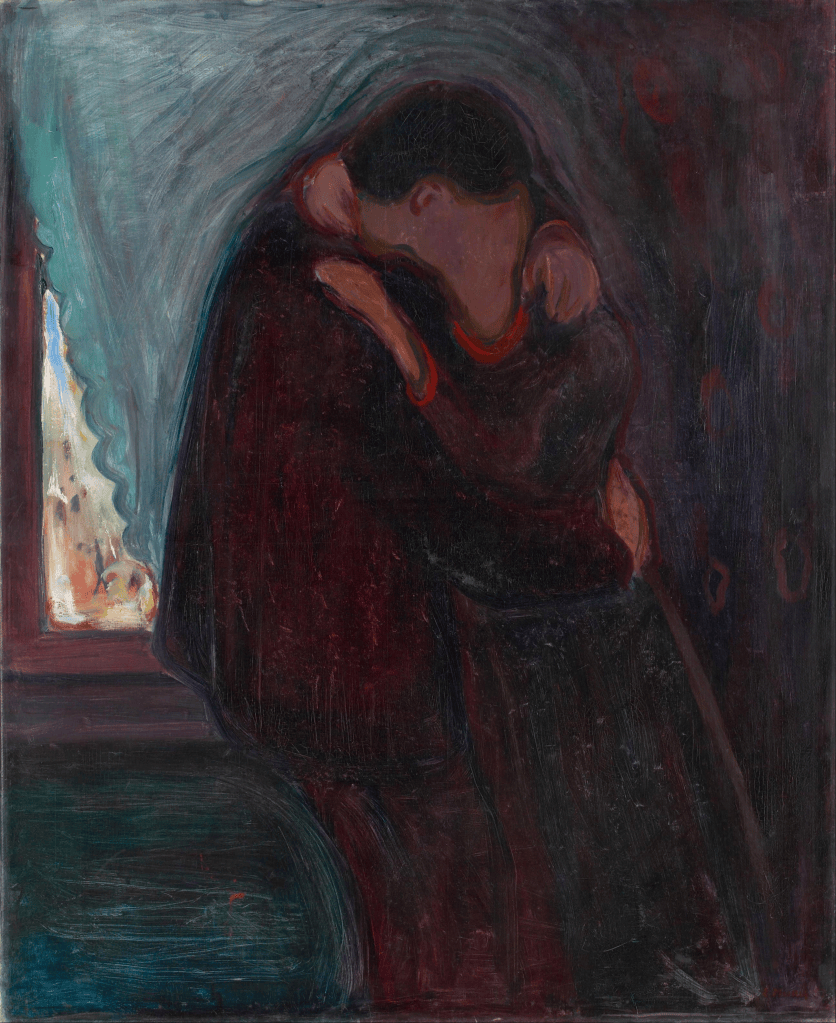
Worshipping nothing only makes a man bow lower than others. Smashing the intellect of their brain against the floor, their abstract thought crumbling without embodiment. And what is the purest form of embodiment if not sex? It’s a truth that passes through the flesh.
If we assign structure to sex — the closest comparison would be religion.
Both religion and sex attempt to resolve the separation between the self and the Other. They both have rituals, require surrender, yearn for a sense of control, involve prohibitions whose violation can make the act feel more significant. Or in other terms — more transcendent. They make invisible commitments legible through the body. But most importantly; they both contain the primal and inherent desire of communion without the abolition of separateness. Likewise, both have a faction of atheism.
Sex produces perhaps the strongest approximation of the impossible; two autonomous bodies attempting to overcome the boundary dividing them and flow beyond the margins. But afterwards, they are still two people. Isn’t the experience of communion with the survival of separation theological by definition?
You want to become completely known by another consciousness on this plane. We always think that of God that God “knows” and “sees” and we find solace in it. But the point is that we want to be fully known or seen as we are at least by someone. Language fails. Thoughts remain private, unsaid, tangled or expressed poorly. Love cannot literally put another person in your subjectivity.
And so, desire may be another place where the human accidentally confesses belief. Belief in the significance of another person — the desire to transcend the isolated self. Sex becomes religion precisely because the physical reckons with the intangible. We cross completely into another person, we are beared witness without translation, we briefly make two things one without destroying either. Sex becomes evidence in an argument about what a human being is.
Can a person know me through my body in a way they cannot through language? Can the body reveal something about me that I have successfully concealed myself?
Can truth exist purely intellectually, or does it have to pass through the flesh? To deny the flesh is the equivalent of existential atheism—which brings us straight to the modern altar of casual sex.
Someone can enormously live inside their own head, feed themselves and starve themselves on it. But physical intimacy presents a certain threat; the body can profess something that the intellect refuses to believe.
Nothing has inherent meaning.
But then why does this particular body matter?
Why does the substitution feel impossible?
Why do we talk of sex being empty or emptying ourselves into it?
Why does touch from one person carry a different ontological status from identical touch by another?
Why jealousy? Why fidelity? (Does it literally soil the communion and make it less sacred? Yes right, because it never feels the same afterwards, that connection after a physical betrayal can never again be recreated)
Why does it make us insane to think about the fact that we might never get to touch the person we want to, to experience that with them when we have a crush or our minds set on them?
Why does the impossibility of that seem deadly, final even?
Why does physical absence hurt?
Suddenly, absolute nihilism finds itself cornered by its own logic. If all bodies are merely matter there should be theoretically a kind of interchangeability to them. But there isn’t. We define bodies actually by those we find interchangeable and those we don’t…and that’s a very grim perception on modern dating but it’s true. We see some bodies as placeholders, and some are even too divine or too sacred for us to touch without us thinking we’d ruin them.
Kazantzakis in ‘Zorba the Greek’ shows the smashing of intellect against embodiment, with the smashing not scared of being aggressive, raw and vulgar. Zorba doesn’t merely think in existence, he doesn’t perform it he eats it, dances it, desires, suffers it. Absorbs the birth of stars everyday, the existence of a mule. The intellectual narrator cannot access this through abstraction.
Zorba to him constantly acts as a vessel for him to get to experience these emotions, and while even inspired he holds himself back as his philosophical dogma won’t fully let go. He thinks he can just test the waters, dip his toes, but this isn’t enough. You need to dive in to swim, otherwise you’re not in the water.
“Last night I had confirmed so palpably for the very first time that the soul, too, is flesh, perhaps more fast- moving, more transparent, more free, but flesh nonetheless. And that flesh in its turn is soul — a bit drowsy, totally exhausted owing to long journeys, overloaded with weighty legacies — yet it, too, awakens at great moments, raises its head, and whisks its five tentacles like wings.”
Constructing an entire philosophy on loneliness around the impossibility of truly being known, only to encounter someone who wants to enter the world you’ve constructed. Sex viewed through that framework isn’t principally erotic. It’s epistemological.
Perhaps another body is like a synonym, we have endless options of descriptions, imagery, metaphors to express an idea and yet it is only one that we feel strongly encapsulates and turns our thoughts from abstraction into something real. Raw. Tangible and clay in which can mold ourselves into. Religion choses its words, eternally as a blueprint, as foundation and as undeniable laws like our soul has chosen another body to believe in without knowing why.
We know we cannot fully reach it, just like prayer. And yet, we perform it anyway. We seek out the divine, not in the clouds, but in the fragile clay of someone else’s hands, trying desperately to prove that we were never really alone to begin with.


Leave a Reply