Ok well, maybe a little.
If you asked me last year, I would have probably not believed you that horror had become my favourite genre. I used to view horror as something dependant on cheap thrills and recycled plot lines. A genre designed to purely serve a momentary adrenaline rush in favour of shock factor.
After my introduction to Mike Flanagan, everything changed.
The Haunting of Hill House was disturbing because it delved into the shadow self and redefined the concept of a ghost:
“I’ve seen a lot of ghosts. Just not the way you think. A ghost can be a lot of things. A memory, a daydream, a secret. Grief, anger, guilt. But, in my experience, most times they’re just what we want to see. Most times, a ghost is a wish.”
I’ll dive deeper in a future essay about why ‘The Bent Neck Lady’ was perhaps the scariest television masterpiece I’ve ever seen.
For now, let me propose a new genre – smart horror.
Smart horror does not have the goal to simply scare you with senseless jump scares. Its intention is to penetrate a deeper dissection of the human condition and confront you with your shadow self. It’s not merely frightening – it’s disturbing because it forces self-reflection.
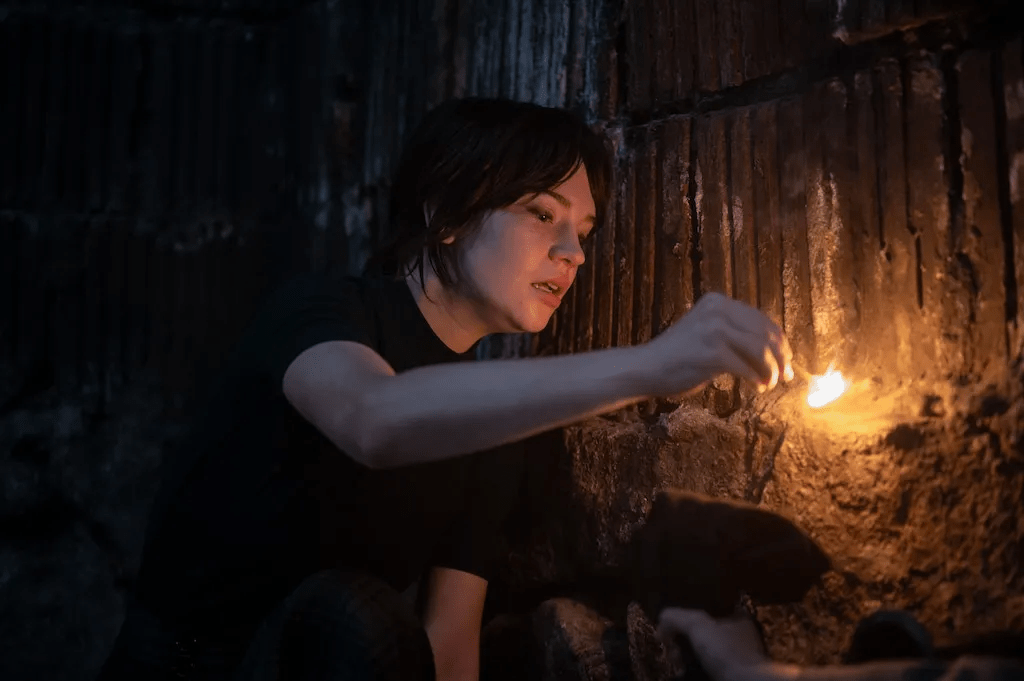
A24’s Heretic is a textbook example.
The story follows two Mormon missionaries who visit a Mr. Reed to share more information about The Church of Our Lord & Savior Jesus Christ, after he expresses interest. What begins as a routine follow up, descends into a harrowing trial of faith. The missionaries find themselves trapped and subjected to physical and spiritual tests.
It’s one of those movies where you directly flock to the reviews knowing how diverse they will be. First, because it can be perceived as blasphemous. Secondly, it was a 1 hour and a 40-minute movie. This means that critics could argue that the film failed to explore topics it introduced on a deeper level. But most of all, it didn’t have any jump scares.
But ask yourself this: Did it make you think? Did it challenge your beliefs and perspectives? If the answer is yes, then you’ve just watched an excellent film.
Movies are a visual medium, unlike books where you’re immersed into the character’s inner thoughts. They rely on the emotion, dialogue and setting to convey meaning. Heretic excels at this, using its visual and narrative tools to provoke introspection.
The use of profound heavy monologue is limited, and instead the conversations feel airy, despite the compound subject. A mastery of cinema – succeeding to avoid overwhelming the viewer with a dense script.
It’s one of the most unsettling films I’ve seen in years—precisely because it didn’t lean on the crutch of jump scares, instead forcing me to question what I’ve believed (or disbelieved) my entire life. And the best part? It allows the ending open to interpretation, letting the viewer’s perception dictate the conclusion.
This is the essence of smart horror: presenting a situation in an original way that questions you, rather than shocking you.
Sure, there are classic horror elements: a basement, a creepy old man, the trapping of two girls. However, Heretic transcends these tropes. The execution is sensational, with all the characters being genuinely likable.
The theological debate at the heart of the film is extraordinary. Both the protagonist and antagonist stand on equal ground, presenting arguments that are easy to follow despite their complexity. Usually, villains in horror are either overly caricatured or so dominant that they overshadow the hero. But here, the balance is perfect. The dialogue is so well-crafted that I could have listened to Hugh Grant (yes, that Hugh Grant) expand on these ideas for hours.
I left the movie knowing more than I came in with. I enhanced my knowledge about history, religion, and faith. Both the hero and the villain make strong cases, questioning faith colliding with a world of disbelief.
How great is a movie when it sparks hours of discussion and debate? When it challenges your deeply embedded perceptions through its dialogue and visuals?
The directors masterfully layer underlying themes, many of which you only catch in hindsight. For example, early in the film, a butterfly trapped in a lamp seems like a classic metaphor for entrapment. But perhaps it’s about breaking free and in seeing the ‘light’ to escape your own fixed narrative.
Predictability is boring; the best movies leave an aftertaste you can’t quite shake. Heretic’s open-ended conclusion is a perfect example. Here are a few interpretations:
A) The butterfly is her friend reincarnated, fulfilling the wish expressed earlier in the film when the final girl said she wanted to be reborn as a butterfly.
B) When she blinks and the butterfly vanishes, it could symbolize the visions people see when they’re dying. Manifestations of what they hope to see, as the antagonist described earlier.
C) A glitch in the simulation. The villain’s earlier nod to the butterfly theory: “Am I a man dreaming I was a butterfly, or a butterfly dreaming I am a man?” adds weight to this.
Most people lean toward A or B, while some argue for C. Either way, the interpretation reflects the viewer’s beliefs. A movie about faith ends by resurfacing your own perception.
Ultimately, Heretic is a triumph of smart horror—a genre that confronts us with our own beliefs, fears, and contradictions. Its open-ended conclusion is the perfect mirror, reflecting the viewer’s own perception and leaving an aftertaste that lingers long after the credits roll.
Where there is grey, there is black and white. And somewhere in between lies the genius of this film.
 Flirting in Space
Leave a reply to linnb2626 Cancel reply