(The Memoirs of a Dreamer)
Ah, White Nights, what a short story! Every time I promise myself that I will read something other than Russian classics, I am effortlessly lured back to them. This book felt like it pierced my brain, as if someone sifted through the chaotic hoarding of my mind.
Many argue that this short story is not Dostoyevsky’s strongest and claim that it is too rushed. And while I can agree that this author has published so many great novels, this short story is exceptional and holds a very dear place in my heart. I will counter that he intended for it to be frantic as “humanity thunders and spins in the whirlwind of life”.
For me, it is also one of the most quotable stories ever written. So, forgive me for the upcoming and relentless citations.
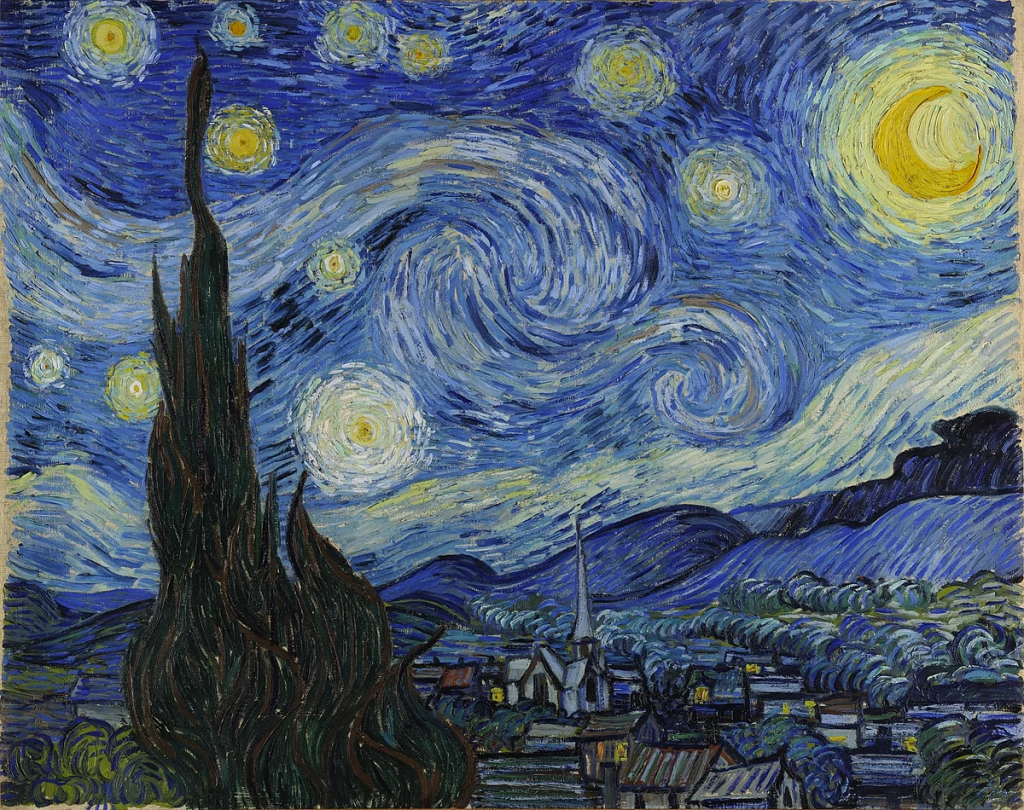
If I could assign this story one piece of art, it would undoubtably be The Starry Night by Van Gogh.
Since making that association, anytime I look at this painting, I am immersed back into White Nights; “It was a wonderful night, the kind of night, dear reader which is only possible when we are young. The sky was so starry, it was such a bright sky that looking at it you could not help but ask yourself: Is it really possible for bad-tempered and capricious people to live under such a sky?”.
Dostoyevsky’s hero is a dependent dreamer that “wove everybody and everything into his canvas, like a fly in a spider’s web”. He lives vicariously through his fantasies and makes no effort to translate them to reality as he views other people’s lives as “pitiful” compared to his own fantastical existence.
Why attempt to struggle for an average life when “he himself is the artist of his life…every hour to suit his latest whim”?
The undeniable answer – love.
The narrator meets Nastenka, a girl that he saves from a persistent gentleman that was following her on the embankment of Saint Petersburg. There is an instant connection, where the two characters feel they can trust each other to share their stories: “I was looking for you and we were fated to meet now – now in my head thousands of valves have opened and I must set loose this river of words, or I will choke to death”.
Over the next few nights they meet, he to confide in someone about his self-imposed isolation, and her to seek advice. What sounds like the anticipation of a love story quickly plummets into a classic tragedy.
The protagonist shares first about his inability to exist and maintain relationships in the real world, due to the disconnection he has created. He considers life to be “a mixture of something purely fantastic, fervently ideal, and at the same time dully prosaic and ordinary”.
The banalities of our existence and the universal fear that we won’t catch up to the spectacular daydreams and goals are common not only in love but in any aspect of life we have envisioned for ourselves. The dreamer is portrayed as a character that seems to be relentlessly caged by his own creation where, “solitude and indolence caress the imagination”.
Nastenka is taken aback by his fervent proclamation. She offers a light-hearted response in which she states that “I am laughing at the fact that you are your own worst enemy”. In her mind, his endless cyclical problem offers a simple solution: he must abandon his imaginary cave and plainly immerse himself into the real world.
In her perception, it is not a sacrifice but a salvation.
This has now formed the duality of the stargazer and the realist. Yet, the short story does not take a stereotypical direction and instead adds layers and nuances to the characters, which they reject in themselves or fail to perceive.
Nastenka is an inhabitant of a world that she brightly tries to embrace despite her grandmother’s constraint. However, she does not realise that she too, is trapped by her own fantasies of being rescued.
Once she gets her first real taste of escapism, through the great potential of love, she fails to physically restrain herself. In a way, she is the antithesis of the narrator, as she is physically bound to her reality, while the narrator shuts himself off to his.
I’ll stop myself short of revealing the plot of the story. As the journey should be undertaken by everyone reading it themselves and identifying with either of the two dualities – or perhaps both.
For me, the plot as beautifully executed as it is, does not hold such a fascination in my eyes as the creation of the two ideologies: two ways of leading life. Two ways of waiting for life to happen to you or for you to happen upon it.
I see myself in the dreamer, almost at uncomfortably so. It reflects in me certain daydreams I find myself in where everything falls into place, yet reality fails to mirror those dreams. The phantoms soar, but my feet are stuck in quicksand. This story serves as a painful yet enticing looking glass – a reminder that these seemingly harmless reveries in which “your fantastic world will grow pale, your dreams will wither, die and scatter like yellow leaves from trees”, disturbed me enough to snap back into the tangible.
“A whole minute of bliss! Is that really so little for the whole of a man’s life?”
 Flirting in Space
Leave a reply to stolzyblog Cancel reply