“September 21, 1945… that was the night I died.”
I won’t rewatch Grave of the Fireflies.
It’s not because I can’t handle difficult material. I tend to gravitate toward it. Psychological horror, philosophical narratives, stories that linger in discomfort. Usually, I can keep a certain distance from what I’m watching. This was the first time that distance collapsed. I had to pause, even with only minutes of the film left.
Animation, for me, removes a layer of mediation. It doesn’t rely on realism to convince you – only on the internal truth of what it shows. There’s nowhere to hide from it. That’s why I return to it so often. It asks questions about the human condition in a way that feels both stripped back and more exposed.
Set in wartime Japan, the film follows two siblings trying to survive after being displaced. But what makes it devastating isn’t the scale of the war. It’s the absence of intervention. No one is actively cruel in any extraordinary way. There is no singular villain. There is only indifference, repeated until it becomes indistinguishable from intent.
It’s easy to frame stories like this around hatred that takes shape in nations, enemies, ideology. This one resists that. It asks something far more uncomfortable: what happens when nothing is done at all.
The children adapt. That’s what makes it difficult to watch. They find ways to survive, and within that, moments of genuine joy. The film doesn’t heighten their reactions to match what we expect from tragedy. It normalises it. And in doing so, it removes the separation the viewer relies on.
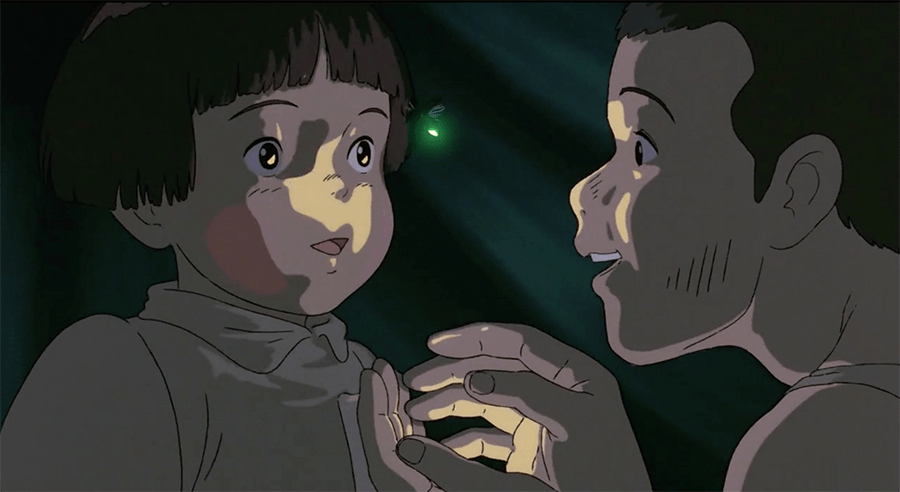
“Why do fireflies have to die so soon?”
My hand was clamped over my mouth for most of the film. By that line, there was a dampness against my skin, arriving before the words fully registered. Only then did I realise I was already crying.
The brutality in that question is in it’s simplicity. It doesn’t attempt to explain anything. It just observes the pattern. They collect the fireflies to bring light into the cave. For a moment, it works. The space becomes softer, magical – a beauty in the eclipse. By morning, they’re all dead. Nothing about that moment is exaggerated. It isn’t framed as a revelation. It’s simply allowed to exist.
And then the film turns. Not suddenly, but decisively.
The girl begins to weaken. There is no dramatic escalation, no single event that marks the shift. Just a gradual failure of the body. Hunger, untreated, becomes terminal. By the time it is acknowledged, it is already too late.
She dies quietly.
Not because no one cared, but because there was no structure left in which care could exist. War had already stripped that away.
That’s what makes the film anti-war in a way that feels unbearable. It doesn’t rely on spectacle. It shows what remains after, when systems collapse, when responsibility dissolves, and survival becomes individual. No one needs to be cruel for something unforgivable to happen.
What the film suggests is not only that war destroys lives, but that it erodes the conditions that make life liveable at all. Not through constant violence, but through absence of food, of care, of intervention.
I won’t rewatch it.
Not because it was too much. But because it removed the distance completely.
 Flirting in Space
Leave a comment